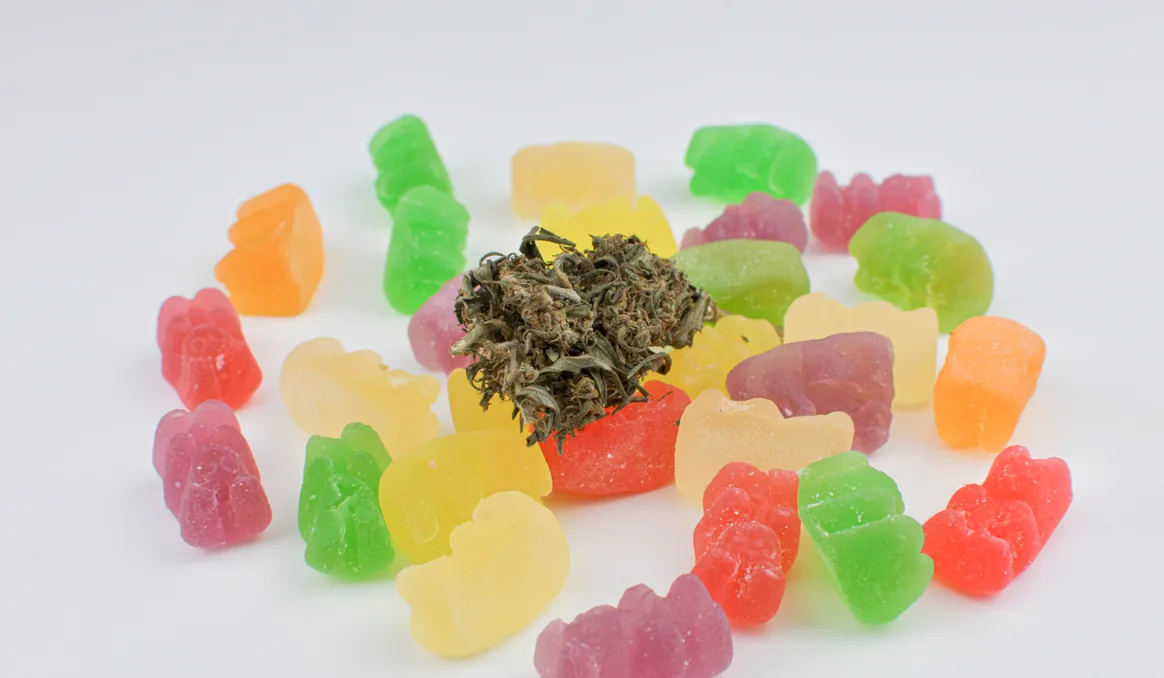

The biggest difference between CBD and THC gummies is the high. THC gummies switch on the brain’s main cannabinoid receptor and change how you feel; CBD gummies don’t, so your head stays clear. THC will show up on a drug test. CBD usually won’t, though trace THC in some CBD products can. Onset, dosing, and legal status differ too.
Below you’ll find a side-by-side comparison, what each one feels like, honest drug-test answers, first-time doses, and what changes for hemp gummies on December 11, 2026.
CBD vs THC Gummies at a Glance
| CBD Gummies | THC Gummies | |
|---|---|---|
| Gets you high? | No. Non-intoxicating. | Yes. |
| How it works | Weak pull on the CB1 receptor; works through other pathways | Activates the CB1 receptor (partial agonist) |
| Commonly reported feel | Calm, centered, mentally unchanged | Mood lift, body ease, altered headspace |
| Typical starting dose | 10 to 25 mg | 2.5 to 5 mg |
| Onset | 30 minutes to 2 hours (both are digested) | 30 minutes to 2 hours |
| How long it lasts | Varies by person and dose | 6 to 12 hours |
| Shows on a drug test? | Unlikely with isolate; possible with full-spectrum | Yes |
| Federal status after Dec. 11, 2026 | Products under 0.4 mg total THC per container are expected to stay legal | Most exceed the new limit |
| Good fit for | Staying sharp, first-timers, people who get drug tested | The full cannabis experience, free evenings |
What Makes CBD and THC Gummies Different?
THC and CBD come from the same plant and look almost identical on paper, but they act on your body in very different ways.
Why THC gets you high
Your body makes its own cannabinoids, such as anandamide, which signal through a receptor called CB1. CB1 is concentrated in the brain and is what drives cannabis’s intoxicating effects. THC fits that receptor and switches it on. Pharmacologists call it a partial agonist at both CB1 and CB2 receptors (Pertwee, British Journal of Pharmacology, 2008). A THC gummy adds more of a signal your receptors already recognize, which is why it changes how you feel.
What CBD does instead
CBD has a much weaker pull on CB1. Instead of switching the receptor on, it can dampen how CB1 responds to other compounds (Laprairie et al., British Journal of Pharmacology, 2015). It also acts on a range of other targets, including serotonin 5-HT1A receptors and TRP channels, and it slows the breakdown of your body’s own anandamide (Stella, Neuron, 2023).
That’s why CBD is described as non-intoxicating. It can affect how you feel, but it doesn’t produce a high. Neither one is “better.” They’re answers to different questions.
How Does Each One Feel?
Everyone responds differently, and your dose, body weight, and what you’ve eaten all matter. Here’s what people commonly report:
- CBD gummies: calm and centered, with no change in how clearly you think. Most people describe it as subtle.
- THC gummies: the experience people usually mean when they say “edible.” Mood lift, body ease, and a noticeable shift in headspace. Intensity scales with dose, so the milligrams of THC per piece are the number that matters most on the label.
How Long Do CBD and THC Gummies Take to Kick In?
Gummies are digested, so they’re slower than smoking or vaping. Edibles can take 30 minutes to 2 hours to kick in, which is why people take a second piece too soon and end up with more than they wanted.
For THC edibles, Minnesota’s Office of Cannabis Management lists peak effects at 3 to 4 hours and a total duration of 6 to 12 hours. Plan for a long, unhurried window, not a quick buzz.
The rule for both: take one serving, then wait at least two hours before deciding whether you need more.
Do CBD Gummies Have THC?
Some do. The label term tells you which kind you’re buying:
- Full-spectrum: contains the plant’s full range of compounds, including a small amount of THC by design.
- Broad-spectrum: keeps many of the plant’s other compounds but is processed to remove THC.
- Isolate: CBD only, with everything else removed.
Labels aren’t always right. A 2022 study tested 80 CBD products off the shelf and found detectable THC in most of them, including 6 broad-spectrum products and 4 isolates. Five of the 21 products labeled “THC Free” contained THC (Johnson, Kilgore & Babalonis, Drug and Alcohol Dependence, 2022).
That’s why we publish batch-matched lab results for what we sell. Before you buy, check the Certificate of Analysis (COA) to confirm what’s actually in the gummy.
Will CBD or THC Gummies Show Up on a Drug Test?
Standard drug tests look for a THC breakdown product called THC-COOH. They don’t look for CBD. Here’s what that means in practice:
- THC gummies will show up. Any product with meaningful THC carries test risk.
- Full-spectrum CBD gummies can show up, especially if you take them daily, because they contain trace THC.
- CBD isolate and broad-spectrum gummies are the lowest-risk option, not a zero-risk one. As the study above shows, even products labeled “THC Free” sometimes aren’t.
If you’re tested: choose isolate or broad-spectrum, confirm “non-detect” for THC on the batch COA, and remember that no CBD product can guarantee a negative test. If your job or sport has zero tolerance, the safest choice is to skip cannabinoid products.
How Much Should You Take the First Time?
Start lower than you think, whichever one you choose.
- CBD: gummies commonly start around 10 to 25 mg per piece. With no high to manage, it’s an easy place to start.
- THC: 2.5 to 5 mg is a common first-time range. If you’ve never had THC, start at 2.5 mg or even half a gummy.
Then follow the edible rule: one serving, wait two full hours, and don’t stack a second piece before the first has fully kicked in. For more beginner guidance, visit our Learn hub.
Is 10 mg of THC and 10 mg of CBD a Lot?
It depends on which half you mean. 10 mg of THC is a full serving and is on the strong side for a first-timer, so start at a quarter or half of that. 10 mg of CBD is a light dose. In a combination gummy, the THC number is the one to dose by, and that small amount of CBD is unlikely to change the THC experience much (see the next section).
Can You Take CBD and THC Together?
Yes, and many products combine them. But the common idea that CBD “softens” THC isn’t settled.
A Johns Hopkins clinical trial gave 18 adults brownies with 20 mg of THC alone or 20 mg of THC plus 640 mg of CBD. The combination produced stronger effects, more impairment, and higher peak THC levels in the blood, because CBD slowed how the body breaks THC down (Zamarripa et al., JAMA Network Open, 2023). The researchers noted this effect was seen with high doses of CBD (more than 600 mg).
Most combination gummies contain a small fraction of that much CBD, and lower doses haven’t been studied the same way. The practical takeaway:
- Dose a combination gummy by its THC milligrams, the same as a THC-only gummy.
- Don’t assume the CBD will cancel out too much THC.
- If you take prescription medications, talk to your doctor before using CBD. It affects the same liver enzymes that process many common drugs.
Side Effects to Know About
THC gummies: dry mouth, red eyes, a faster heart rate, slower reaction time and coordination, and short-term memory lapses. Taking too much can cause anxiety or paranoia (Minnesota Office of Cannabis Management). Never drive after taking a THC gummy. Never drive after taking a THC gummy. For a fuller breakdown, see our guide to THC gummies side effects.
CBD gummies: generally well tolerated, but the FDA lists possible drowsiness, digestive upset, mood changes, interactions with other medications, and liver effects at high doses (FDA). Combining CBD with alcohol can increase drowsiness.
For both: store gummies locked up and out of reach of children and pets. They look like candy. If someone eats one by accident, call Poison Control at 1-800-222-1222.
Are CBD and THC Gummies Legal? What Changes on December 11, 2026
Right now: the 2018 Farm Bill allows hemp-derived products with no more than 0.3% Delta-9 THC by dry weight. That’s what makes hemp-derived THC gummies and CBD gummies legal to sell federally today.
On December 11, 2026: a new federal law (P.L. 119-37, Section 781) changes the definition of hemp. It measures total THC, and it caps finished products at 0.4 mg of total THC per container (Saul Ewing analysis).
What that means for gummies:
- THC gummies: a single typical gummy contains many times the 0.4 mg per-container limit, so most hemp-derived THC gummies won’t qualify as hemp after the deadline.
- Full-spectrum CBD gummies: many contain enough trace THC to exceed the limit.
- CBD isolate and broad-spectrum gummies that test under the limit are expected to remain available.
This section reflects federal law as of November 18, 2026. The effective date has already moved once, and we’ll update this page if it changes again. State rules vary, and you must be 21 or older to buy THC products from us. This isn’t legal advice.
Already Using CBD? How to Try THC for the First Time
If you’re a CBD regular curious about THC, think of it as a dose question, not a leap.
- Choose a low-dose THC gummy (2.5 to 5 mg) rather than anything marketed by intensity.
- Take it at the start of a free evening at home, with no plans to drive.
- Wait at least two hours before considering more.
- Expect the mental shift CBD never gave you. At a low dose, it arrives gently.
If it feels like too much, use a lower dose next time. Many people end up keeping both: CBD for days that need a clear head, THC for evenings that don’t. If you want to try hemp-derived THC gummies, keep the December 11 deadline above in mind.
From Our Budtenders
“The first thing almost everyone asks is, ‘Will this one get me high?’ I flip the pack over and show them the milligrams. If they want to stay clear-headed for work or the gym, I point them to CBD. If they want to relax on a night off, we look at a low-dose THC gummy. The second question is usually about drug tests, and I’m honest: THC will show up, and even CBD isn’t a guarantee unless it’s isolate with a clean COA.”
Jen, Budtender, Asheville Dispensary West Asheville
“I pull up the COA on my phone right at the counter. I show customers the batch number, have them match it to the jar, and point out the total THC line. That one number tells you more than anything on the front of the package. For a first THC gummy, I suggest 2.5 mg, or half a 5 mg gummy, and I tell everyone the same thing: wait two full hours before you even think about taking more.”
Jake, Budtender, Asheville Dispensary South Slope
So Which Gummy Should You Choose?
- Want to stay clear-headed? Choose a CBD gummy.
- Want the classic cannabis experience? Choose a low-dose THC gummy and give it time.
- Get drug tested? Choose CBD isolate or broad-spectrum, check the COA, and accept that the risk isn’t zero.
- Taking medications? Check with your doctor before using either.
Compare both side by side: CBD edibles and THC gummies. Questions? Ask any of our budtenders in store.
Frequently Asked Questions
Will a CBD gummy get me high?
No. CBD is non-intoxicating. A full-spectrum CBD gummy contains only trace THC, typically far too little to produce a high.
Do CBD gummies have THC in them?
Full-spectrum gummies contain trace THC by design. Broad-spectrum and isolate gummies are processed to remove it, but testing has found THC in some products labeled “THC Free.” Check the batch COA.
How long does a THC gummy last?
Effects usually begin within 30 minutes to 2 hours, peak around 3 to 4 hours, and can last 6 to 12 hours.
Which is better for a first-timer?
If you want no high at all, CBD. If you want to try THC, start at 2.5 mg and wait two full hours before taking more.
Will CBD gummies still be legal after December 11, 2026?
CBD products with no more than 0.4 mg of total THC per container are expected to remain legal under the new federal definition. That generally means isolate or broad-spectrum products that test under the limit.
Sources
- Pertwee RG. The diverse CB1 and CB2 receptor pharmacology of three plant cannabinoids. British Journal of Pharmacology, 2008. View source
- Laprairie RB, et al. Cannabidiol is a negative allosteric modulator of the cannabinoid CB1 receptor. British Journal of Pharmacology, 2015. View source
- Stella N. THC and CBD: Similarities and differences between siblings. Neuron, 2023. View source
- Johnson E, Kilgore M, Babalonis S. Cannabidiol (CBD) product contamination: Quantitative analysis of Delta-9-THC concentrations found in commercially available CBD products. Drug and Alcohol Dependence, 2022. View source
- Zamarripa CA, et al. Assessment of orally administered Delta-9-THC when coadministered with cannabidiol on Delta-9-THC pharmacokinetics and pharmacodynamics in healthy adults. JAMA Network Open, 2023. View source
- Centers for Disease Control and Prevention. Cannabis poisoning. View source
- Minnesota Office of Cannabis Management. Safer Cannabis Use. View source
- U.S. Food and Drug Administration. What You Need to Know (And What We’re Working to Find Out) About Products Containing Cannabis or Cannabis-derived Compounds, Including CBD. View source
- Saul Ewing. Congress Enacts Hemp THC Products Ban: What the New Federal Restrictions Mean for the Industry. View source
You must be 21 or older to purchase THC products. These statements have not been evaluated by the Food and Drug Administration. These products are not intended to diagnose, treat, cure, or prevent any disease. This article is for educational purposes and is not medical or legal advice. Consult your healthcare provider before using cannabinoid products, especially if you are pregnant, nursing, or taking medication.