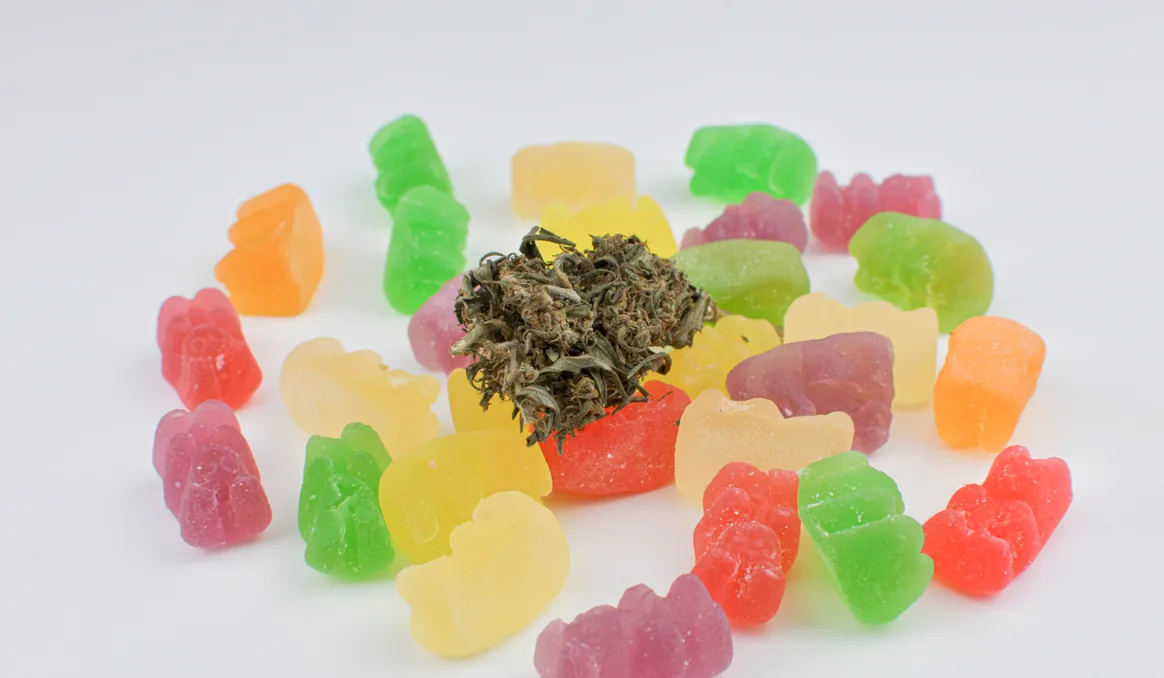
Do hemp gummies have THC? Some do and some don’t. “Hemp” tells you which plant the ingredients came from, not what’s in the gummy. A hemp gummy can be a hemp seed oil gummy with no meaningful THC, a CBD gummy with none or a little, or a hemp-derived THC gummy with a full dose. The cannabinoid panel on the label tells you which one you’re holding.
Below you’ll find the five types side by side, why a hemp gummy can legally contain THC, a 10-second label check, and honest answers on getting high and drug tests.
Types of Hemp Gummies at a Glance
| What’s in it | THC per gummy | Gets you high? | Shows on a drug test? | |
|---|---|---|---|---|
| Hemp seed oil gummy | Oil pressed from hemp seeds; no CBD or THC added | None meaningful | No | Very unlikely |
| CBD isolate or broad-spectrum gummy | CBD, processed to remove THC | None listed | No | Unlikely, not impossible |
| Full-spectrum CBD gummy | CBD plus the plant’s other compounds, including some THC | Trace to a few mg | Usually no; check the mg | Possible |
| Hemp-derived THC gummy | Delta-9 or delta-8 THC from hemp | A full dose, often 2.5 to 10 mg | Yes | Yes |
| Blend gummy | THC plus CBD, CBG, or CBN in set ratios | Varies by product | Yes, from the THC | Yes |
Why Can a Hemp Gummy Contain THC?
Hemp and marijuana are the same plant species, Cannabis sativa, bred into different varieties. Hemp is generally low in delta-9 THC and high in CBD (Congressional Research Service). The word “hemp” describes the plant, not the product.
Under the 2018 Farm Bill, hemp is cannabis with no more than 0.3% delta-9 THC by dry weight (Congressional Research Service). That limit is a percentage, and a gummy weighs several grams. A 4-gram gummy at 0.3% could hold up to 12 mg of THC, which is a full dose for most adults. That’s how a hemp gummy can deliver the same THC experience as any other THC gummy.
What’s Actually in Each Type of Hemp Gummy?
Hemp seed oil gummies
These are the “hemp gummies” you see in grocery stores and online marketplaces. Hemp seeds don’t naturally contain THC or CBD, and the FDA has said hemp seed ingredients aren’t capable of making anyone high (FDA). If the label lists hemp seed oil and no cannabinoids in milligrams, it’s this type.
CBD gummies: isolate, broad-spectrum, and full-spectrum
- Isolate: CBD only.
- Broad-spectrum: many of the plant’s compounds, processed to remove THC. Example: our Single Serve Broad Spectrum CBD Gummy (50 mg CBD).
- Full-spectrum: the whole range of compounds, including some THC by design. Our 27mg CBD Gummies contain 27 mg of full-spectrum CBD and 3 mg of delta-9 THC per gummy. The name says CBD, and the panel tells you the rest.
More on the difference in our guide to full spectrum CBD.
Hemp-derived THC gummies
These contain real, active THC, labeled in milligrams per piece. Many use delta-9 THC, and some use delta-8, which is roughly half as strong. See delta 8 vs delta 9 gummies for how they compare.
Blend gummies
These combine THC with CBD and other cannabinoids in set amounts. Small Axe Delta 9/CBD Gummies – Forbidden Fruits contain 20 mg CBD, 10 mg delta-9 THC, 3 mg CBG, and 2 mg CBN per gummy. Dose a blend by its THC number.
How to Tell What’s in Your Gummy in 10 Seconds
- Find the cannabinoid panel. It lists each cannabinoid in mg. “CBD 25 mg, THC 0 mg” is a CBD gummy. “THC 5 mg” is a THC gummy. No cannabinoids listed usually means hemp seed oil.
- Read mg per piece, not per package. A “100 mg” pack of ten is 10 mg per gummy.
- Check the extract type on CBD products. Isolate and broad-spectrum are processed to remove THC. Full-spectrum keeps some.
- Confirm with the lab report. A label is a claim. A batch-matched Certificate of Analysis is a measurement.
Step 4 matters more than most shoppers realize. A 2022 study tested 80 CBD products and found detectable THC in most of them, including some isolates and broad-spectrum products. Five of the 21 products labeled “THC Free” contained THC (Johnson, Kilgore and Babalonis, Drug and Alcohol Dependence, 2022). We publish batch-matched results on our COA page, and our guide on how to read a lab report walks through what each line means.
Will a Hemp Gummy Get You High?
It depends entirely on which type you’re holding.
- Hemp seed oil gummy: no.
- CBD gummy: no. THC switches on the brain’s CB1 receptor, which drives the high (Pertwee, British Journal of Pharmacology, 2008). CBD doesn’t; it can actually dampen how that receptor responds (Laprairie et al., British Journal of Pharmacology, 2015). A full-spectrum CBD gummy with a few mg of THC may be noticeable to someone sensitive, so check the THC line.
- Hemp-derived THC gummy: yes. THC is THC, whichever variety of the plant it came from. A 5 mg hemp-derived delta-9 gummy feels like any other 5 mg delta-9 gummy.
- Blend gummy: yes, from the THC. The other cannabinoids shape the experience.
The rule for every type: “hemp” isn’t a strength. The milligrams of THC per gummy are. If you’re new to THC, start at 2.5 to 5 mg and wait two full hours before taking more.
Will Hemp Gummies Fail a Drug Test?
Standard drug tests look for a THC breakdown product, not for hemp or CBD.
- Hemp seed oil gummies: very unlikely to cause a positive.
- CBD isolate and broad-spectrum gummies: the lowest-risk CBD option, not a zero-risk one, since labels aren’t always accurate.
- Full-spectrum CBD gummies: can cause a positive, especially with daily use.
- Hemp-derived THC and blend gummies: will show up.
If you’re tested, see how CBD vs THC gummies compare and our cannabis drug testing guide.
From Our Budtenders
“People pick up a bag that says hemp and assume it’s mild. I flip it over and point at the THC line. If it says 10 mg, it’s a real THC gummy, no matter what plant it came from. If they want nothing at all, I show them where ‘broad-spectrum’ or ‘isolate’ is written and pull up the COA.”
Brady, Budtender, Asheville Dispensary West Asheville
“The one that surprises people is full-spectrum CBD. Our 27 mg CBD gummy also has 3 mg of THC. That’s great for some customers and a dealbreaker for anyone who gets drug tested, so I always mention it.”
John, Budtender, Asheville Dispensary South Slope
Hemp Gummies vs THC Gummies: Which Do You Actually Want?
- No high, no THC? A CBD isolate or broad-spectrum gummy.
- Calm with a little THC in the mix? A full-spectrum CBD gummy. Check the THC mg.
- The classic THC experience? A hemp-derived THC gummy, starting at 2.5 to 5 mg.
- THC with CBD or CBN alongside? A blend gummy.
- Get drug tested? CBD isolate or broad-spectrum only, confirmed on the COA.
Shop both side by side: CBD edibles and THC gummies.
Frequently Asked Questions
Are hemp gummies the same as THC gummies?
Not always. Some hemp gummies contain a full dose of THC, and others contain none. The cannabinoid panel on the label tells you which.
Do hemp gummies make you feel anything?
Hemp seed oil gummies don’t. CBD gummies are commonly described as calming without a high. Hemp-derived THC gummies produce a high like any other THC gummy.
Does hemp get you high like THC?
Hemp itself is low in THC, but THC extracted from hemp works the same way as THC from any cannabis plant.
How much THC can a hemp gummy have?
Hemp is defined by a 0.3% delta-9 THC limit by weight. Because a gummy weighs several grams, it can hold several milligrams of THC, often 2.5 to 10 mg per piece.
Are hemp seed gummies the same as CBD gummies?
No. Hemp seed oil gummies contain no meaningful CBD or THC. CBD gummies list CBD in milligrams on the label.
Sources
- Congressional Research Service. Defining Hemp: A Fact Sheet (R44742), 2019. View source
- U.S. Food and Drug Administration. FDA Responds to Three GRAS Notices for Hemp Seed-Derived Ingredients for Use in Human Food, 2018. View source
- Johnson E, Kilgore M, Babalonis S. Cannabidiol (CBD) product contamination: Quantitative analysis of Delta-9-THC concentrations found in commercially available CBD products. Drug and Alcohol Dependence, 2022. View source
- Pertwee RG. The diverse CB1 and CB2 receptor pharmacology of three plant cannabinoids. British Journal of Pharmacology, 2008. View source
- Laprairie RB, et al. Cannabidiol is a negative allosteric modulator of the cannabinoid CB1 receptor. British Journal of Pharmacology, 2015. View source
You must be 21 or older to purchase THC products. These statements have not been evaluated by the Food and Drug Administration. These products are not intended to diagnose, treat, cure, or prevent any disease. This article is for educational purposes and is not medical or legal advice. Consult your healthcare provider before using cannabinoid products, especially if you are pregnant, nursing, or taking medication.