
The legal landscape for hemp-derived cannabinoids in Tennessee underwent a seismic transformation on January 1, 2026. With the implementation of comprehensive new legislation (HB 1376/SB 1413), the state has shifted from a regulated marketplace to one of the strictest prohibitionist frameworks in the nation.
For the thousands of Tennesseans employed in the hemp industry and the consumers who rely on these products, the stakes could not be higher. According to a legal filing citing the Whitney Economics 2023 National Cannabinoid Report, Tennessee’s hemp-derived cannabinoid industry employs an estimated 6,495 workers who collectively earn more than $260 million in annual wages.
Whether you are a consumer wondering if you can still legally purchase THCA flower in Tennessee or a business owner navigating the transition period through June 30, 2026, this guide provides a definitive analysis of the law based on government documents, legislative texts, and economic reports.
Understanding Tennessee’s THCA Legal Status (January 2026 Update)
As of January 1, 2026, THCA exists in a precarious legal gray zone defined by a strict “Total THC” calculation and a temporary transition window. The new law transferred regulatory authority from the Tennessee Department of Agriculture (TDA) to the Alcoholic Beverage Commission (TABC), signaling a shift toward treating hemp products with the same scrutiny as alcohol and controlled substances.
Crucially, the legislation reclassifies Tetrahydrocannabinolic acid (THCa) and Tetrahydrocannabiphorol (THCp) under state law. According to the Tennessee General Assembly Fiscal Note for HB 1148, these substances have been added to the list of Schedule VI controlled substances. This creates a Class A misdemeanor offense for manufacturing, producing, or selling a product containing compliant hemp-derived cannabinoids if they exceed the new strict limits.
However, the ban is not immediate for everyone. A “grandfather” clause allows businesses that were licensed before December 31, 2025, to continue operating under the previous 2023 framework until June 30, 2026. After this date, full enforcement begins.
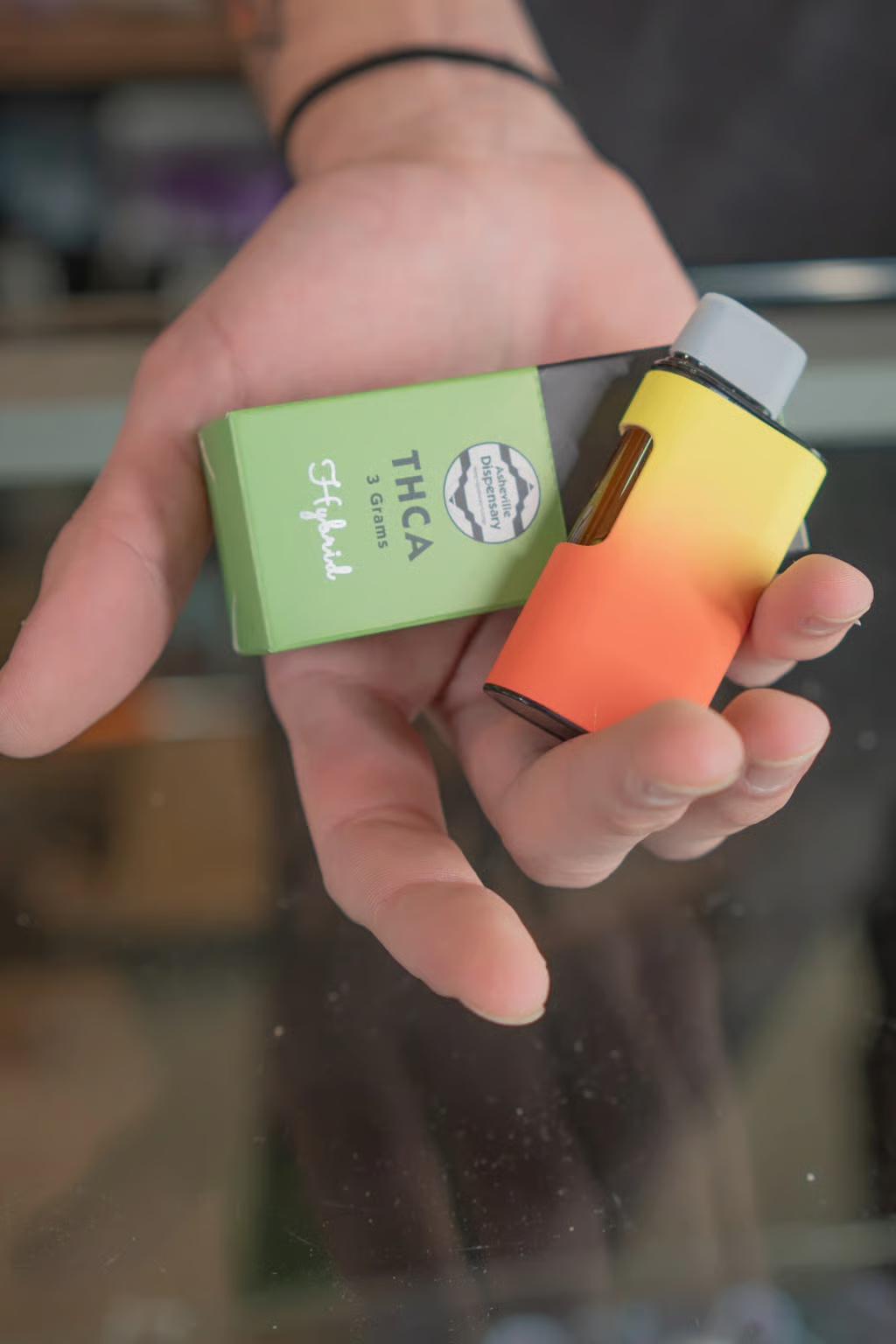
Licensed retailers like Asheville Dispensary operate in full compliance with Tennessee’s evolving regulations.
What Is THCA? The Science Behind Tennessee’s Ban
To understand the law, one must first understand the chemistry. THCA (tetrahydrocannabinolic acid) is the non-psychoactive precursor to Delta-9 THC. In raw cannabis plants, THCA is the dominant cannabinoid. It does not produce a “high” until it is heated—a process known as decarboxylation.
THCA vs. THC: Understanding the Chemistry
When you smoke, vape, or cook THCA, it loses a carboxyl group (CO2) and converts into psychoactive Delta-9 THC. Tennessee lawmakers have argued that this potential for conversion means THCA should be regulated exactly like marijuana.
How Tennessee’s “Total THC” Calculation Works
Under the Tennessee Hemp Production Plan approved by the USDA, the state requires a specific testing methodology to determine legality. The generally accepted formula for calculating compliance is:
Total THC = (Conc THCA × 0.877) + Conc Δ9-THC
The 0.877 multiplier accounts for the mass lost during decarboxylation. If the result of this equation exceeds 0.3% on a dry weight basis, the product is illegal in Tennessee. This effectively bans high-THCA flower, which may have 0.2% Delta-9 THC but 20% THCA. Under the formula, that flower would be calculated as (20 × 0.877) + 0.2 = 17.74% Total THC, far above the legal limit.
Furthermore, the state mandates testing via liquid chromatography tandem mass spectrometry (LC-MS/MS). Unlike gas chromatography, which uses heat and automatically converts THCA to THC during testing, LC-MS/MS allows labs to measure THCA and Delta-9 separately before applying the mathematical formula.
Tennessee THCA Laws: A Complete Timeline
The path to prohibition has been incremental. Understanding the legislative history helps clarify why the rules are changing now.
2019: Post-Farm Bill boom. Tennessee hemp licenses surged from 111 to 2,331 growers in just three months.
2023: Public Chapter 423 enacted. Established a 6% sales tax on hemp-derived cannabinoids and set basic regulations, including a 21+ age limit and a 25mg serving size cap.
2025: HB 1148/SB 1236 & HB 1376 passed. Reclassified THCA as a Schedule VI controlled substance and transferred regulatory power to the Alcoholic Beverage Commission.
January 1, 2026: New Law Takes Effect. The strict Total THC standard is officially law. New businesses must comply immediately. Online sales are banned.
June 30, 2026: Transition Period Ends. The last day for “legacy” licensees (those licensed before Dec 31, 2025) to sell products under the old rules. After this, full prohibition enforcement begins.
THCA Possession Penalties and Consequences
The penalties for violating Tennessee’s new cannabis laws are severe. While hemp was previously a civil regulatory issue, it is now a criminal one.
Class A Misdemeanor Charges
For consumers, possession of hemp products that exceed the 0.3% Total THC limit is treated as possession of marijuana. Under Tennessee Code Annotated § 39-17-418, simple possession is a Class A misdemeanor punishable by up to 11 months and 29 days in jail and fines up to $2,500.
Felony Charges for Sales and Distribution
For business owners, the risks are higher. Manufacturing, delivering, or selling non-compliant products is a Class E felony, which carries a sentence of 1 to 6 years imprisonment and fines up to $5,000. Distribution amounts can lead to Class B felonies with up to 30 years in prison.
Civil Penalties and Product Seizure
The Tennessee Alcoholic Beverage Commission has broad enforcement powers. They can issue civil fines of $1,000 per violation and have the authority to seize and destroy non-compliant inventory immediately. For detailed information on safe, compliant products, visit our THCA collection.
Where to Buy THCA in Tennessee (Legally)
Despite the crackdown, legal purchasing options remain for compliant products during the transition period. However, the rules for how you buy have changed drastically.
Compliant retailers must keep all hemp-derived products behind the counter, accessible only by staff.
Licensed Retail Requirements
Under the new law, all hemp-derived cannabinoid products must be kept behind the counter and inaccessible to customers without staff assistance. Purchases are strictly limited to adults 21 and older with valid government ID.
Cities with THCA Retailers
Major metropolitan areas like Nashville, Memphis, Knoxville, and Chattanooga still have licensed retailers operating under the transition rules. For example, our Chattanooga dispensary continues to serve customers with fully compliant, lab-tested products.
What to Look for in a Licensed Retailer
Always verify that the retailer holds a valid license from the Tennessee Department of Revenue (or TABC post-transition). Products must feature child-resistant packaging and a QR code linking to a Certificate of Analysis (COA) proving compliance.
THCA and Employment: Drug Testing Concerns
A common misconception is that “legal” hemp products won’t cause failed drug tests. This is false. Standard drug panels test for THC metabolites (THC-COOH), which your body produces when processing THCA, Delta-9 THC, or even Delta-8. Because THCA is chemically almost identical to THC, consuming it will result in a positive drug test.
Tennessee is an “at-will” employment state, meaning employers can fire workers for positive drug tests even if the product consumed was legally purchased. Exercise extreme caution if your employment depends on drug screening.
Economic Impact: How the THCA Ban Affects Tennessee
The economic fallout of the THCA ban is projected to be devastating for the state’s agricultural and retail sectors. Data from the Whitney Economics 2023 National Cannabinoid Report reveals the scale of the industry being dismantled.
| Economic Metric | Value (Tennessee) |
| Total Economic Impact | $734.6 Million |
| Total Output | $561.2 Million |
| Direct Sales | $282.7 Million |
Jobs at Risk: 6,500 Workers and $260 Million in Wages
The industry supports 6,495 jobs in Tennessee, generating over $260 million in annual wages. These are not just retail clerk positions; they include farmers, lab technicians, manufacturing specialists, and logistics professionals whose livelihoods are now threatened.
Tax Revenue Loss: $11.3 Million Annually
According to the Tennessee Department of Revenue 2025 Hemp Report, the state collected $11,302,772.73 in tax revenue from hemp products in Fiscal Year 2024 alone. The ban puts this revenue stream at risk. In fact, tax collections for December 2024 dropped to $996,419 from $1.5 million the previous year—a 34% decline—as market uncertainty took hold.
Industry Market Contraction: 75% of Products Banned
Industry experts testified before the legislature that the Total THC standard will render approximately 75% of the current market illegal. This includes almost all smokable hemp flower and most vapes, decimating the most profitable segments of the industry.
Tennessee vs. Other States: How Does THCA Law Compare?
Tennessee’s restrictive approach makes it an outlier in the region, particularly regarding medical access.
Neighboring States’ Medical Cannabis Programs
While Tennessee imposes felony penalties for THC, its neighbors have established robust medical programs. According to the Tennessee Medical Cannabis Commission 2025 Annual Report:
- Arkansas: 170,755 active patient ID cards (5.6% of population)
- Florida: 800,356 active patient ID cards (3.6% of population)
- Missouri: 197,929 active patient ID cards (3.2% of population)
- Tennessee: 0 active patients (Population: 6.97 million)
Tennessee remains one of the few states in the nation with no functional medical cannabis program, leaving patients with no legal alternative once the hemp ban takes full effect.
States with Similar THCA Restrictions
Tennessee is joining a small group of states like Arkansas and Rhode Island that have implemented “Total THC” laws specifically to close the THCA loophole. However, most other states with such bans offer a medical marijuana program as an alternative pathway for patients—Tennessee does not.
As the laws change, consumers are encouraged to stay informed and prioritize safety by choosing compliant, lab-tested products.
What Happens Next? The Future of THCA in Tennessee
The future remains uncertain but critical developments are on the horizon. The transition period through June 30, 2026, provides a small window for legislative adjustment.
Potential Federal Rescheduling Impact
The U.S. Department of Health and Human Services has recommended moving cannabis to Schedule III. If the DEA finalizes this rescheduling, it could force Tennessee to revisit its harsh criminal penalties. As noted in the Medical Cannabis Commission report, federal rescheduling would acknowledge the medical utility of cannabis, contradicting Tennessee’s current stance.
Legislative Outlook for 2026 and Beyond
The Tennessee Medical Cannabis Commission struggled to meet quorum throughout 2024, hampering policy recommendations. However, with 90% of U.S. adults supporting some form of legalization, pressure on state lawmakers is mounting. Until the laws change, consumers must navigate the current restrictions carefully.
For more information on the evolving legal landscape, read our guide on Is THCA Legal in 2026?.
Frequently Asked Questions About THCA in Tennessee
Is THCA legal in Tennessee right now?
It is in a transition period. As of January 1, 2026, high-THCA products are effectively banned by the new Total THC law. However, retailers licensed before Dec 31, 2025, can continue selling under old rules until June 30, 2026. After that date, possession becomes a Class A misdemeanor.
What are the penalties for possessing THCA?
Possession of non-compliant hemp products is a Class A misdemeanor punishable by up to 11 months and 29 days in jail and fines up to $2,500. Selling such products is a felony carrying 1-6 years in prison.
Can I buy THCA online in Tennessee?
No. The new law explicitly bans online sales and direct-to-consumer shipping of hemp-derived cannabinoids. Purchases must be made face-to-face at licensed retail locations.
What is the difference between THCA and THC?
THCA is the non-psychoactive precursor to THC found in raw cannabis. It converts to THC when heated. Tennessee law now treats them as legally equivalent by using a “Total THC” calculation (THCA × 0.877 + THC).
When does the THCA ban take full effect?
The law technically took effect January 1, 2026, but full enforcement for all retailers begins after the transition period ends on June 30, 2026.
Disclaimer: This article is for educational purposes only and does not constitute legal advice. Laws regarding cannabis and hemp are subject to rapid change. Always consult with a qualified attorney in your jurisdiction.