

The legal landscape for hemp-derived cannabinoids in Georgia underwent a seismic shift in 2024. With the passage of Senate Bill 494, Georgia fundamentally redefined how hemp products are regulated, effectively closing the “loophole” that allowed high-potency THCA flower to be sold in retail stores.
For consumers and business owners alike, the situation is complex. While the Georgia hemp industry contributes approximately $150 million annually in state taxes, the new regulations have introduced strict “Total THC” standards that include THCA in the 0.3% limit. This state-level change was further complicated by a November 12, 2025 federal amendment (Pub. L. No. 119-37) that aligned federal law with Georgia’s strict standards, creating a unified but restrictive national framework.
Whether you are looking to purchase THCA products or understand the future of the industry, this guide breaks down the specific legal statutes, scientific principles, and compliance requirements that now govern the Peach State.
What Is THCA? Understanding the Chemistry
Tetrahydrocannabinolic acid (THCA) is the non-intoxicating acidic precursor to Delta-9 THC. In raw cannabis plants, THCA is actually the dominant cannabinoid, not THC. According to the Michigan Cannabis Regulatory Agency, cannabis plants in their natural form produce primarily THCA rather than Delta-9 THC.
This distinction is critical because THCA itself does not produce a psychoactive “high.” It only becomes intoxicating when it undergoes decarboxylation—a chemical reaction triggered by heat.
How THCA Converts to THC (Decarboxylation)
When THCA is exposed to heat (smoked, vaped, or cooked), it loses a carboxyl group (CO₂) and converts into Delta-9 THC. Research published in PubMed Central confirms that this process occurs rapidly at temperatures between 200-290°F (93-143°C).
This chemical conversion is the basis for Georgia’s “Total THC” law. Because THCA eventually becomes THC when consumed, regulators argue it should be treated as “potential THC.”
Scientific Insight: The 0.877 Conversion Factor
During decarboxylation, the THCA molecule loses mass as it releases carbon dioxide. Specifically, it loses about 12.3% of its weight. This is why the legal formula uses the 0.877 multiplier: 1 gram of THCA does not equal 1 gram of THC; it equals 0.877 grams of THC.
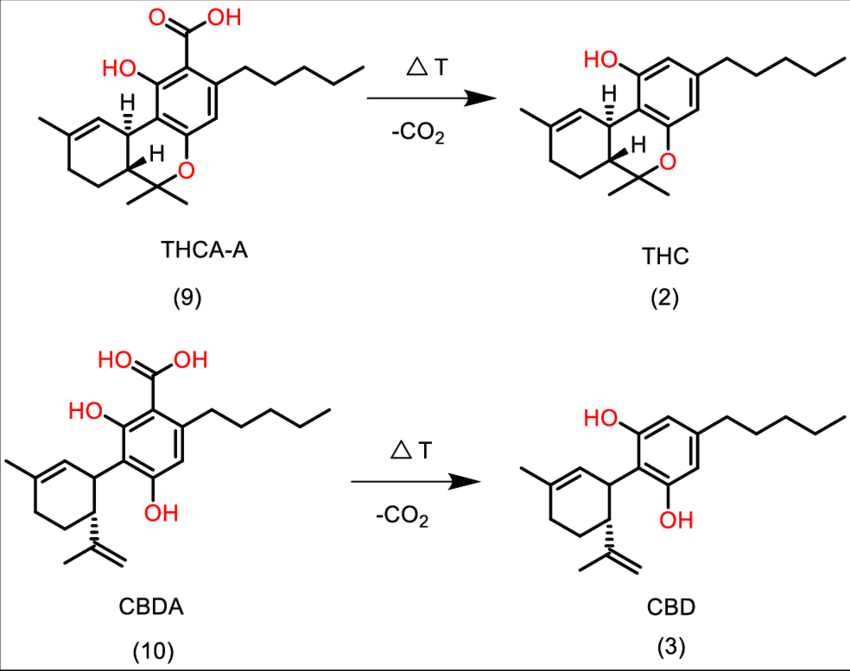
Visual representation of THCA converting to THC through heat (decarboxylation).
Georgia’s Total THC Law: SB 494 Explained
Senate Bill 494 is the piece of legislation that changed everything. Signed by Governor Brian Kemp in April 2024, it established a rigorous testing protocol that accounts for the potential conversion of THCA into THC.
Under the rules published by the Georgia Department of Agriculture, compliance is calculated using the following formula:
Total THC = (0.877 × THCA) + Delta-9 THC
If the result of this calculation exceeds 0.3% on a dry weight basis, the product is classified as marijuana (a Schedule I controlled substance in Georgia) rather than legal hemp. This standard applies to all final products, not just the raw crop.
Staggered Implementation Timeline
One source of confusion has been when these laws actually took effect. SB 494 rolled out in two distinct phases:
- July 1, 2024: Zoning restrictions took effect. This prohibited hemp businesses from operating within 500 feet of schools.
- October 1, 2024: The major provisions went live, including the Total THC testing requirement, age restrictions (21+), and the ban on unprocessed flower sales.
Is THCA Flower Legal in Georgia?
You can buy THCA flower online in Georgia, however, retail sales are illegal in Georgia. As of October 1, 2024, the retail sale of THCA flower is illegal in Georgia for two distinct reasons:
- The Unprocessed Flower Ban: According to the text of SB 494, it is explicitly “unlawful to sell unprocessed flower or leaves of the hemp plant at retail,” regardless of its THC content. This is a blanket ban on smokable flower products.
- The Total THC Limit: Even if flower were allowed, most high-THCA strains would fail the new 0.3% Total THC test. A strain with 20% THCA would calculate as 17.5% Total THC (20 × 0.877), far exceeding the legal limit.
Can You Order THCA Flower Online in Georgia?
Yes, pursuant to the Agriculture Improvement Act of 2018 (2018 Farm Bill), THCA flower is federally legal to ship provided it contains no more than 0.3% Delta-9 THC on a dry weight basis.
To learn more about safety concerns related to flower products, read our guide on whether THCA flower is sprayed.
What THCA Products Are Banned in Georgia?
Beyond flower, Georgia has instituted specific milligram limits for “consumable hemp products.” These rules are designed to limit potency and prevent accidental intoxication.
Gummies and Edibles
Edibles face strict caps. A single serving (one gummy) cannot contain more than 10mg of Total THC. Furthermore, the entire package is capped at 300mg of Total THC. This effectively bans high-potency edibles that were previously common.
Beverages
Hemp-infused drinks are limited to 10mg of Total THC per 12-ounce container. Additionally, these beverages cannot be packaged or sold in a way that mimics alcohol products, nor can they contain alcohol.
Tinctures and Oils
Tinctures are restricted to 2mg of Total THC per milliliter, and the maximum container size is 60ml (2 ounces). This severely limits the available potency for users seeking therapeutic doses.
Federal Law Changes: The November 2025 Amendment
While Georgia was an early adopter of the “Total THC” standard, the federal government has now followed suit. On November 12, 2025, a critical amendment (Pub. L. No. 119-37) was enacted that changed the federal definition of hemp.
According to the Congressional Research Service, the new federal definition explicitly includes “total THC concentration (including THCA)” at the 0.3% limit. This amendment closes the “Farm Bill loophole” that allowed the THCA industry to flourish nationally.
How Federal Law Now Aligns with Georgia
Previously, businesses could argue that federal law only counted Delta-9 THC, ignoring THCA. Georgia’s SB 494 made that argument moot within the state. Now, federal law aligns with Georgia, creating a unified enforcement standard. The amendment also introduced a federal cap for final products: no more than 0.4 milligrams of combined total THC per container for certain product classes, which is even stricter than Georgia’s 10mg limit.
Cannabis Rescheduling Executive Order
Complicating matters further, on December 18, 2025, an executive order was issued instructing the Attorney General to expedite the process of rescheduling marijuana from Schedule I to Schedule III. While this does not legalize recreational sales, it acknowledges the medical value of cannabis and may eventually lead to a more regulated pharmaceutical pathway for high-THC products.
For ongoing updates on federal legislation, check our 2025 Federal Hemp Bill Update.
Georgia’s Hemp Industry: Economic Impact
The restrictive nature of these laws has raised concerns about economic fallout. The hemp industry is a significant economic driver in the state. According to a 2024 University of Georgia economic impact report, the industry contributes an estimated $150 million annually in state taxes.
The agricultural footprint is also substantial. USDA data shows that there were 117 growers registered for the 2025 season in Georgia. These farmers, along with at least 80 hemp CBD stores operating in the state, face significant revenue losses under the ban on flower and high-potency products.
National Context
For comparison, the 2024 value of hemp production in the open nationally was $258 million. Georgia’s contribution is vital to the national market, particularly given that University of Georgia College of Agricultural and Environmental Sciences research shows hemp biomass yields are highest in northern Georgia, exceeding 600 lbs per acre.
How to Verify Product Compliance in Georgia
If you are purchasing legal hemp products in Georgia (like low-dose gummies or CBD), verifying their safety is crucial. Georgia law mandates rigorous testing standards that go beyond simple potency checks.
Testing must be conducted by DEA-registered laboratories. These labs are required to use specific scientific methods (like liquid chromatography) that utilize the 0.877 conversion factor to verify Total THC compliance.
Understanding the Full Panel Certificate of Analysis
A Certificate of Analysis (COA) is a document from a third-party lab that confirms what is in your product. In Georgia, a “Full Panel” COA is required. This means the product must be tested for:
- 12 Cannabinoids: Including THC, THCA, CBD, CBDA, CBG, CBG-A, CBN, Delta-8, Delta-10, and others.
- Residual Solvents: Chemicals left over from the extraction process.
- Heavy Metals: Lead, arsenic, mercury, and cadmium.
- Pesticides: Harmful agricultural chemicals.
- Microbial Impurities: Mold, yeast, and bacteria (mycotoxins).
Always look for a QR code on the packaging that links directly to this document. You can learn more about finding and reading these reports on our COA page.
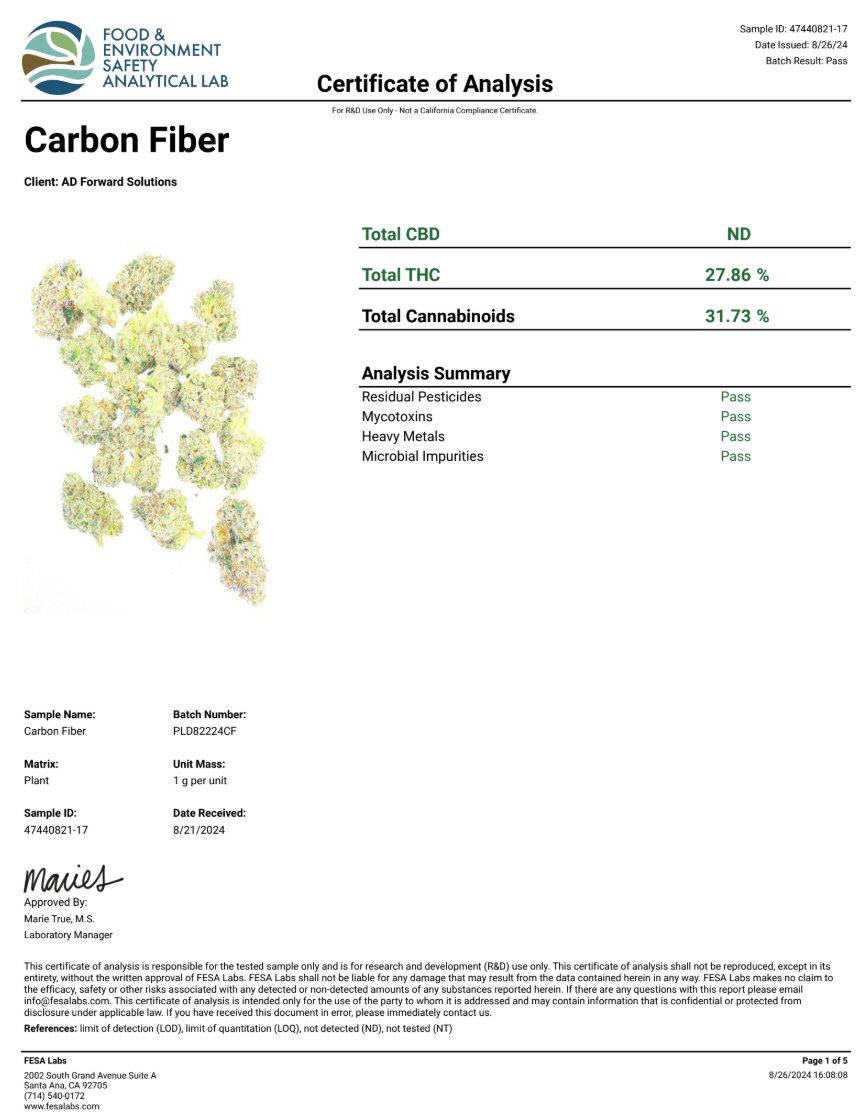
An example of a full panel Certificate of Analysis (COA) required for legal compliance.
Medical Cannabis vs. Hemp THCA: Access Options
With the restriction of the THCA market, many Georgia residents are turning to the state’s existing medical cannabis program. While more bureaucratic, this pathway offers legal protection and access to products with higher THC limits.
Georgia’s Low-THC Oil Registry currently serves over 33,700 patients, along with 2,300 caregivers and 700 registered physicians. Unlike the hemp market, which is capped at 0.3% THC, medical patients can possess low-THC oil containing up to 5% THC by weight.
| Feature | Hemp Market (THCA) | Medical Cannabis Program |
| Legal Limit | 0.3% Total THC | 5% THC (Oil only) |
| Flower Sales | Banned | Banned |
| Access | 21+ Retail (Restricted) | Registry Card Required |
| Availability | Convenience/CBD Stores | Licensed Dispensaries (approx. 14) |
Penalties for THCA Violations in Georgia
Ignoring these regulations carries severe consequences. For businesses, operating without the proper licenses—which range from $250/year for retail to $10,000/year for wholesale—can result in closure and heavy fines.
For individuals, possession of non-compliant THCA flower (which tests as marijuana) is treated the same as possession of marijuana. In Georgia, possession of more than one ounce is a felony punishable by up to 10 years in prison. Even possession of less than one ounce is a misdemeanor that can result in jail time and fines.
Future Outlook: What’s Next for THCA in Georgia?
The regulatory environment remains fluid. The federal amendment passed in November 2025 has an effective date of November 12, 2026 (one year after enactment), giving the industry a brief grace period to adjust to national standards.
In Georgia, growers facing the December 1, 2025 reporting deadline for the 2025 season are already adapting to the new reality. The industry is likely to shift toward compliant, lower-potency full-spectrum CBD products and Delta-9 specific edibles that meet the 0.3% dry weight limit through careful formulation.
Frequently Asked Questions
Is THCA flower legal in Georgia?
No. SB 494 explicitly bans the retail sale of unprocessed hemp flower, and the Total THC testing requirement makes almost all THCA flower non-compliant.
Can you buy THCA in Georgia?
You cannot legally buy high-THCA products in Georgia retail stores. Only products with less than 0.3% Total THC (like certain low-dose edibles) are permitted.
What is the total THC law in Georgia?
Georgia uses the formula: Total THC = (THCA × 0.877) + THC. The result must be 0.3% or less on a dry weight basis for the product to be legal.
When did Georgia ban THCA?
The ban was effectively finalized on October 1, 2024, when the retail provisions of SB 494 took effect. Zoning restrictions began earlier on July 1, 2024.
Is THCA the same as THC?
Chemically, no. THCA is the acidic precursor to THC and is non-intoxicating. However, Georgia law treats them as functionally equivalent because THCA converts to THC when heated.
Disclaimer: This guide is for educational purposes only and does not constitute legal advice. Cannabis laws change frequently. Always consult with a qualified attorney regarding specific legal questions. For customer support inquiries regarding our products, please visit our support page.


